

For decades, the popular image of a security guard was singular and often unflattering: the “tough guy.” This stereotype depicted a burly individual with crossed arms, a stern glare, and an eagerness to physically remove anyone who stepped out of line. In that old paradigm, security was viewed strictly as a force of intimidation. The effectiveness of a guard was measured by their physical imposingness and their willingness to use it.
However, the world has changed, and the security industry has had to evolve rapidly to keep pace. In today’s litigious society, where every interaction can be recorded on a smartphone and uploaded instantly to social media, the “tough guy” approach is not just outdated—it is a massive liability.
Today, the most effective weapon in a security professional’s arsenal is not a baton, handcuffs, or pepper spray. It is their voice, their empathy, and their ability to de-escalate a volatile situation before it turns physical.
At 365 Patrol, we believe that the true measure of a security professional is not how many fights they win, but how many they prevent. This article explores the critical importance of de-escalation training, the psychology of conflict resolution, and why Alberta businesses must prioritize “soft skills” to ensure hard security.
The High Cost of Aggression: The Business Case for De-escalation
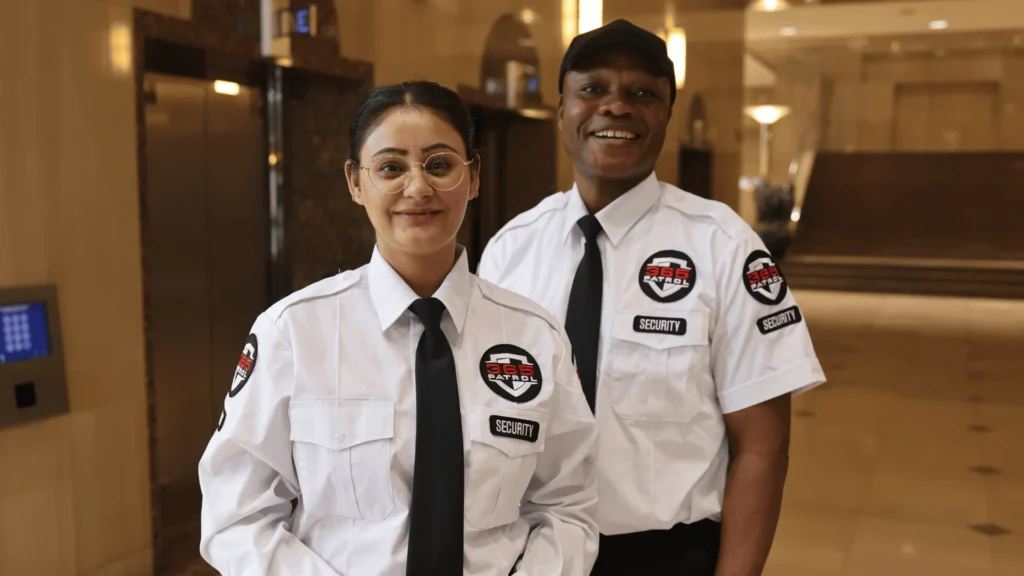
Before diving into the techniques of de-escalation, it is vital for business owners and property managers to understand the financial and reputational stakes involved. Choosing a security provider that prioritizes “hands-off” resolution isn’t just a moral choice; it is a strategic business decision.
1. Liability and Litigation
The fastest way for a business to lose money is a lawsuit resulting from an excessive use of force. If a security guard physically engages a trespasser or a disruptive customer, the risk of injury—to the subject, the guard, or bystanders—skyrockets.
In Canada, the use of force is strictly regulated by the Criminal Code. Security personnel are only permitted to use as much force as is “reasonable and necessary.” However, what a guard deems necessary in the heat of the moment and what a court deems necessary months later can differ wildly.
By emphasizing de-escalation, businesses drastically reduce the probability of physical altercations. A conversation that ends with a trespasser walking away voluntarily costs $0. A conversation that ends in a tackle can cost tens of thousands in legal fees, settlements, and increased insurance premiums.
2. The “Viral Video” Era and Brand Reputation
We live in the age of the citizen journalist. Almost every patron in a mall, hospital, or event venue carries a high-definition camera in their pocket. When a security interaction turns physical, context is often lost, but the visual of a guard struggling with a civilian is powerful and damaging.
A video of a security guard aggressively handling a situation can go viral globally in hours, causing irreparable damage to the client’s brand. The public does not distinguish between the “contract security company” and the “business.” If it happens in your lobby, it is your reputation on the line.
De-escalation preserves dignity. It allows the subject to save face, which often diffuses their anger, and it ensures that if cameras are recording, your security team looks professional, calm, and in control—not aggressive and chaotic.
3. Workplace Safety and Employee Retention
Physical altercations are dangerous for guards. The highest cause of workplace injury in the security sector is violence. When guards are trained to use their words first, they are safer. Safer guards are happier guards, leading to lower turnover rates and more consistent service for clients.
What is De-escalation? (It’s Not Just “Being Nice”)
A common misconception is that de-escalation means being passive, weak, or “letting people get away with it.” This is false.
De-escalation is strategic communication. It is the art of gaining voluntary compliance. The goal is to get the individual to do what you want them to do (leave the property, stop yelling, put down the item) because they choose to, not because they are forced to.
It involves a combination of psychology, body language, tone management, and active listening. It turns a conflict into a conversation, and a conversation into a resolution.
The Psychology of Escalation
To de-escalate, a guard must understand why people escalate. Usually, aggression is a reaction to fear, frustration, loss of control, or humiliation. When a person enters a state of high emotional arousal (anger/panic), their prefrontal cortex—the part of the brain responsible for logic and reasoning—shuts down. They are operating on pure “fight or flight” instinct.
If a security guard meets aggression with aggression (shouting back, stepping into their space), they trigger the subject’s threat response, guaranteeing a fight. De-escalation aims to lower that emotional temperature so the subject’s logic center can turn back on.
Core Pillars of De-escalation Training
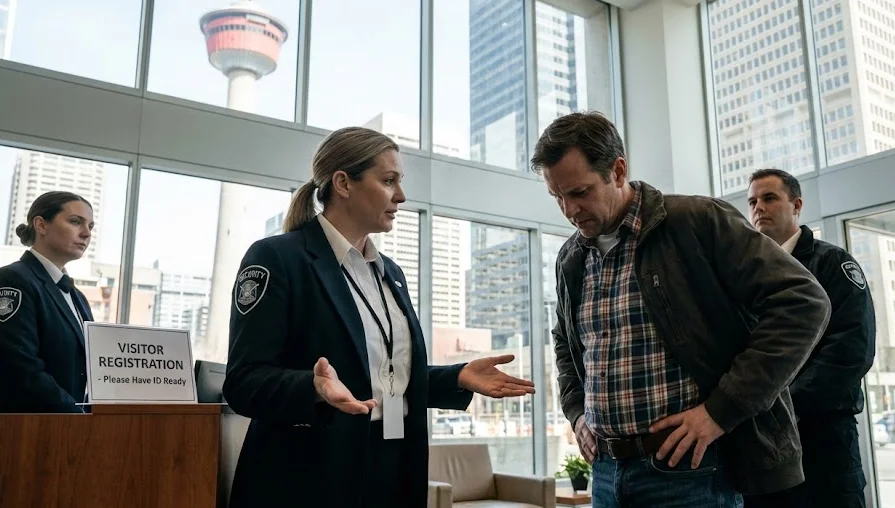
At 365 Patrol, our training goes beyond the basic provincial licensing requirements. We focus on “Verbal Judo” and tactical communication. Here are the core pillars effective security personnel must master.
1. Non-Verbal Communication: The 55/38/7 Rule
Studies suggest that communication is roughly 55% body language, 38% tone of voice, and only 7% the actual words spoken. A guard can say “Please calm down,” but if they are clenching their fists, standing too close, and shouting, the message received is a threat.
- The Blade Stance: Trained guards never stand “square” (chest to chest) with an agitated person, as this looks confrontational. They stand at an angle (bladed). This protects their vital organs but also subconsciously signals “I am not here to fight you.”
- Open Hands: Keeping hands visible and open (palms out or low) signals safety. Hidden hands or crossed arms signal danger or judgment.
- Space Management: Respecting the “reactionary gap.” Getting in someone’s face is the quickest way to start a punch-up. Maintaining a safe distance lowers the subject’s anxiety.
2. The Art of Active Listening
Often, a disruptive person just wants to be heard. They are shouting because they feel ignored—by the receptionist, by the system, or by society.
“Tactical Empathy” is a powerful tool. It involves:
- Paraphrasing: “Let me make sure I understand. You’re upset because your appointment was cancelled, is that right?”
- Validating: “I understand why that would be frustrating.”
- Redirecting: “I can’t fix the appointment schedule, but here is what I can do to help you right now.”
When a guard validates a person’s feelings, the person often runs out of steam. The “fight” leaves them because there is no longer an “enemy” pushing back.
3. Tone and Volume Control
A whisper can be louder than a shout. When a subject raises their voice, the untrained instinct is to shout over them to establish dominance. The professional instinct is to lower the voice.
By speaking slowly, calmly, and quietly, the guard forces the subject to stop yelling and lean in to hear. It breaks the cycle of escalation. It projects confidence—only people who are afraid or out of control need to scream.
4. Mental Health Awareness
In urban centers like Edmonton and Calgary, security personnel frequently interact with individuals suffering from mental health crises or substance abuse issues. These are not “bad guys”; they are people in distress.
Standard command-and-control techniques (“Stop! Get on the ground!”) often fail spectacularly with these demographics because the individual may not be processing reality clearly. De-escalation training teaches guards to recognize the signs of a crisis (incoherent speech, erratic movements) and switch from “enforcement mode” to “support mode,” prioritizing medical assistance over criminalization.
Real-World Applications: De-escalation in Action
How does this training translate to the specific environments 365 Patrol serves?
The Retail Environment (Loss Prevention)
Scenario: A teenager is caught shoplifting. They are scared, embarrassed, and cornered.
- The Old Way: Grab them, handcuff them, drag them through the store. Result: The teen fights back, shelves get knocked over, customers film it, lawsuits follow.
- The De-escalation Way: The guard approaches calmly, keeps a distance, and speaks quietly. “Hey, I think you forgot to pay for that item in your pocket. Why don’t we go to the office and sort this out quietly so we don’t make a scene?”
- Result: The teen complies to avoid public embarrassment. The merchandise is recovered. No one gets hurt.
The Healthcare Setting (Hospitals/Clinics)
Scenario: A frantic family member is denied entry to the ER due to capacity limits. They are screaming at the nurse.
- The Old Way: “Sir, you need to leave or I will remove you.” Result: The father punches the guard out of desperation and grief.
- The De-escalation Way: “I know you are worried about your son. I know this is incredibly hard. But shouting at the nurse is actually slowing down the doctors. I need you to wait here so they can focus on him. Can I get you a water?”
- Result: The father feels understood. His focus shifts from fighting the staff to worrying about his son. He complies.
The Office Building (Access Control)
Scenario: A fired employee returns, demanding to see the boss.
- The Old Way: Physical blocking and intimidation. Result: The situation escalates to workplace violence.
- The De-escalation Way: The guard acknowledges the anger. “I can’t let you up right now, but I can take a message or call them for you. Let’s step over here to the side so we can talk privately.”
- Result: The individual is moved away from the secure zone (the elevators) voluntarily, and the guard buys time for police to arrive if necessary.
When Force is Necessary: The “Last Resort” Philosophy
It is important to clarify that de-escalation training does not mean security guards never use force. There are situations where immediate physical intervention is required to protect life or prevent serious bodily harm.
However, at 365 Patrol, we operate on the Use of Force Continuum.
- Officer Presence: Just being there.
- Verbal Direction: Asking/Ordering.
- Empty Hand Control: Soft physical restraint (guiding).
- Defensive Tactics: Hard physical restraint.
De-escalation allows us to resolve 95% of incidents at levels 1 and 2. Because our guards are better at the first two levels, they rarely have to resort to the higher levels. But if they do, it is legally defensible because they can prove they exhausted every other option first.
Why 365 Patrol is Leading the Standard in Alberta
The security industry is unregulated in terms of the quality of soft-skills training. Many budget security firms provide the bare minimum instruction required to get a license and put a uniform on a body. This “warm body” model is a recipe for disaster.
365 Patrol takes a different approach. We view our security personnel as professionals, akin to first responders.
1. Hiring for Temperament
We do not just hire for size; we hire for emotional intelligence (EQ). We look for individuals with backgrounds in customer service, social work, or community leadership—people who know how to talk to people. You can teach a calm person to be vigilant, but it is very hard to teach an aggressive person to be calm.
2. Continuous Education
De-escalation is a perishable skill. It requires practice. We invest in ongoing training scenarios for our staff, role-playing high-stress situations so that when the real thing happens, the guard doesn’t panic—they revert to their training.
3. Specialized Sector Matching
We match the guard’s personality to the site. A guard who excels at a quiet construction site night watch might not be the right fit for a busy downtown ER waiting room. We ensure that the guards placed at high-interaction sites are our strongest communicators.
Conclusion: The Best Fight is the One That Never Happens
In the modern business landscape of Edmonton and Calgary, the definition of “security” has expanded. It is no longer just about locks and patrols; it is about creating an environment of safety and hospitality.
A security guard who escalates conflict is not a security asset; they are a liability. They bring danger to your doorstep rather than keeping it away.
By prioritizing de-escalation training, 365 Patrol ensures that our clients receive a service that protects their property, their people, and their reputation. We provide guards who are confident enough to be kind, professional enough to remain calm, and skilled enough to resolve conflicts without chaos.
Is your current security provider protecting your reputation, or putting it at risk?
Contact 365 Patrol today to discuss how our professionally trained, de-escalation-focused security teams can provide a safer, smarter solution for your business.

